What is GEO? Generative Engine Optimization Explained
Classic SEO optimizes for Google. But in 2026, AI models like ChatGPT, Claude, Perplexity, and Google AI Overview decide daily which websites they recommend to their users - by completely different rules. Here's how GEO works and how to meaningfully improve your score in 60 minutes.
What is GEO (Generative Engine Optimization)?
GEO stands for Generative Engine Optimization (sometimes also called AI search optimization or ChatGPT SEO) - optimizing your website for AI models like ChatGPT, Claude, Perplexity, Gemini, or YouChat. The term was coined in 2023 in the GEO research paper from Princeton, Georgia Tech, and the Allen Institute for AI. While SEO aims to rank high in Google's search results, GEO makes sure AI models recognize your website as a trustworthy source and cite it in their answers.
The difference is fundamental: Google ranks by keywords, backlinks, and technical signals. AI models, by contrast, look for structured, citable content, clear entity definitions, and trust signals. A website that ranks on page 1 of Google can still be invisible to AI models - and vice versa.
Why does GEO matter in 2026?
ChatGPT has over 900 million weekly users according to OpenAI (as of February 2026). Perplexity delivers directly cited sources as an answer engine instead of a list of links, and keeps growing rapidly. Claude is increasingly used in business workflows. More and more people no longer ask Google - they ask an AI.
If you don't show up in these answers, you visibly lose reach - even if your Google rankings don't change at all. That's the blind spot in most 2026 SEO strategies.
Key takeaway
GEO doesn't replace SEO - it complements it. If you only optimize for Google today, you're leaving a growing channel untapped. The websites that start building GEO signals now will have a clear edge in 2027.
GEO vs. SEO: What's the difference?
| Aspect | SEO (Google) | GEO (AI models) |
|---|---|---|
| Goal | Ranking in search results | Being cited in AI answers |
| Core factor | Keywords & backlinks | Structured data & clarity |
| Technical | robots.txt, sitemap, Core Web Vitals | llms.txt, Schema.org, FAQ schema |
| Content | Keyword density, E-E-A-T | Citable facts, clear definitions |
| Measurement | Rankings, impressions, CTR | GEO score, crawler access, mentions |
What are the 6 most important GEO signals?
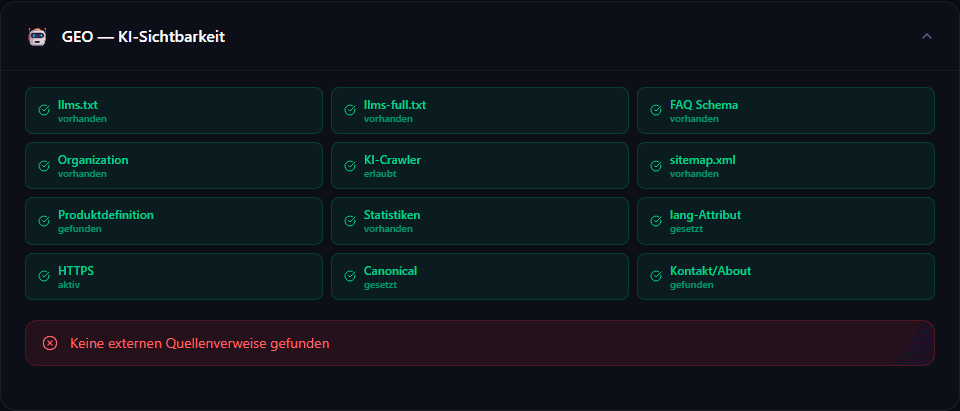
AuditAI checks 19 GEO signals in total. These are the six with the biggest impact:
Create llms.txt
The single most important GEO file. Create a file at /llms.txt with a clear description of your website, your products, and your key points. Structure it with Markdown headings. Add /llms-full.txt for a detailed version.
# MyTool
> MyTool is an X for Y that does Z in under 60 seconds.
Source: llms.txt specification (llmstxt.org) ↗llms.txt explained in depth →
Schema.org structured data
JSON-LD in the head of your page. At minimum, Organization schema (name, URL, logo), FAQPage schema for common questions, and depending on your website type, SoftwareApplication or Product.
Source: Official Schema.org documentation ↗Schema markup for AI citations in detail →FAQ schema with real HTML content
Important: FAQ schema in JSON-LD alone isn't enough. The questions and answers also need to exist as visible HTML text on the page. AI models scrape the visible content - not just the head.
Allow AI crawlers in robots.txt
Many websites unknowingly block AI crawlers. Make sure GPTBot, ClaudeBot, anthropic-ai, PerplexityBot, and YouBot are explicitly allowed in your robots.txt.
User-agent: GPTBot
Allow: /

User-agent: ClaudeBot
Allow: /
Source: Official crawler docs: OpenAI GPTBot ↗
Clear product definition
AI models need an unambiguous "X is Y for Z" definition. Write, in one of the first paragraphs of your homepage, precisely what your tool is, who it's for, and what problem it solves. Avoid marketing fluff.
E-E-A-T signals
Experience, Expertise, Authoritativeness, Trustworthiness. AI models favor sources with an identifiable author, contact details, a privacy policy, and an imprint. An /about page with founder info significantly increases trust.
Which AI models benefit from GEO?
Not all AI models work the same way. There are two fundamental types:
RAG-based systems (Retrieval Augmented Generation) like Perplexity or Bing Copilot crawl the web in real time and cite sources directly. GEO signals take effect fastest here - within days to weeks.
Models with a training cutoff like ChatGPT (without browsing) or Claude (without web access) only know content from their training data. It takes longer here - but the more your website is discussed across the public web (GitHub, Reddit, Hacker News, product pages), the higher the chance of being picked up in future training runs.
Hybrid systems like ChatGPT with browsing enabled or Claude with web access combine both approaches. For these, a solid technical GEO foundation (llms.txt, Schema.org, clean canonicals) is especially important.
Which 10 GEO quick wins should you implement first?
Frequently asked questions about GEO
What is GEO (Generative Engine Optimization)?
GEO stands for Generative Engine Optimization. It refers to optimizing a website so AI models like ChatGPT, Claude, or Perplexity recognize it as a trustworthy source and cite it in their answers. Similar to how SEO optimizes for Google's algorithms, GEO targets indexing and use by generative AI systems.
What is the difference between GEO and SEO?
SEO optimizes for search engines like Google, which rank by keywords and backlinks. GEO optimizes for AI models, which look for structured data, clear entity definitions, and citable content. Both matter and complement each other.
What is llms.txt and why does it matter?
llms.txt is a text file in a website's root directory (similar to robots.txt) that's specifically readable by AI models. It describes what the website is, what it offers, and which content is relevant for AI crawlers. Many AI crawlers read llms.txt as their first orientation.
What is "ChatGPT SEO"?
"ChatGPT SEO" is a colloquial term for GEO with a specific focus on ChatGPT - optimizing a website so ChatGPT mentions or recommends it in its answers. Technically, GEO is the broader term for all AI models, but the underlying techniques are identical: structured data, llms.txt, clear product definitions, and citable facts.
How long does it take for GEO to show results?
RAG-based systems like Perplexity react to technical GEO signals within days to weeks. Models with a fixed training-data cutoff like GPT-4 can take months until the next training update. Technical quick wins like llms.txt and AI crawler access work fastest.
How good is your GEO score?
AuditAI checks all 19 GEO signals in under 60 seconds - including llms.txt, Schema.org, AI crawler access, and content quality. Start without registration, sign up free for the full report with all scores.
Check your GEO score now